
Note concerning the publication date of BfR2GO
BfR2GO 1/2026 was released in June 2026. The next issue will be published in December 2026. Internal Link:Subscribe
Exposed
Listen to the article:
Exposure is a basic concept in risk assessments. The extent to which an organism is exposed to a potentially harmful substance is a key factor in determining the health risk.
What does poison have to do with classical music? Surprisingly more than one might assume at first. One important element of classical music is exposition: the musical theme is introduced at the beginning of a composition.
This exposition has much in common with the exposure which is so central to toxicology, the science of poisons. But in toxicology, it is not a melody that is being presented.
Rather, it is a potentially dangerous substance, such as a toxin (poison) or a chemical, to which a person is exposed. There is no poison without exposure. Furthermore, the larger the amount (dose) of the toxin, the greater the exposure and thus the health risk. And this is where the analogy to the beautiful sounds of classical music ends.
Whether or not a substance can cause harm to a person is not just down to the substance. It also depends on the duration and the intensity of the exposure. As such, determining exposure is central in human health risk assessments. This plays a role in, for example, the assessment of chemicals, impurities (contaminations), and residues in foodstuffs or when it comes to the use of plant protection products. For the German Federal Institute for Risk Assessment (BfRshort forGerman Federal Institute for Risk Assessment), which focuses strongly on these topics, comprehensive and precise understanding of the exposure to a substance is of central importance.
Inhaled, ingested, absorbed via the skin
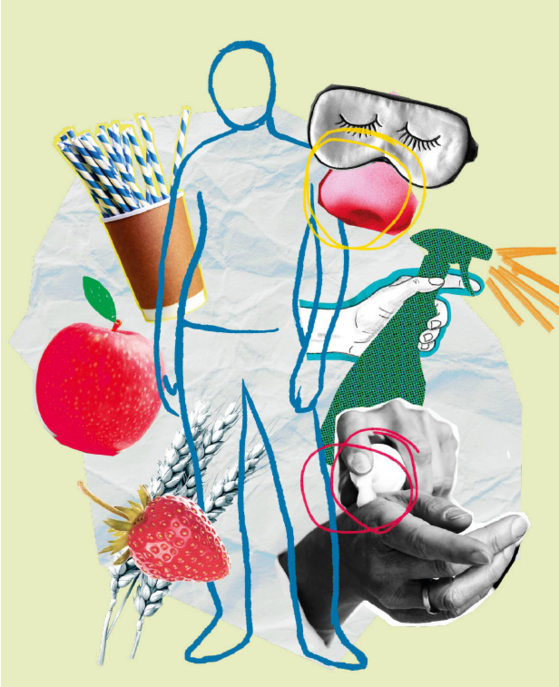
There are three main pathways through which a substance can enter the human body. It can be breathed in (inhaled) or ingested (oral intake) or absorbed by the body through the skin (dermal intake). It is not just the dose that determines the activity; the route of exposure is central, too. A chemical which is ingested is transported via the intestine to the “detoxification centre” that is the liver, where it may in some cases already be “diffused”. By contrast, if a substance is inhaled, it enters directly and often very quickly into the bloodstream. Intake through the skin is yet another case. “The skin is an underestimated organ when it comes to forming a barrier against toxins,” says pesticide expert and BfRshort forGerman Federal Institute for Risk Assessment Vice-President Dr Tewes Tralau. “It has an incredible and unique ‘detoxing’ talent.”
So, it is not only a question of the dosage of a substance, but also of the route of entry into the body and the extent to which the substance is absorbed. Whether exposure is sudden (acute) or constant (chronic) must also be considered. 50 milligrams of strychnine, a poison formed by plants, can be life-threatening if taken all at once. However, if strychnine is taken over 20 days in daily amounts of 2.5 milligrams, the effect is not deadly, despite the total dose being the same.
Chemicals, chemicals everywhere
Food and drink, furniture, clothing, cosmetics, work and leisure: we encounter countless substances and articles every day which contain tens of thousands of chemical compounds.
It is the central task of the BfRshort forGerman Federal Institute for Risk Assessment to determine if consumers are exposed to a health risk through consumer goods. This is why exposure is a crucial topic for the institute. First, a reliable classification of the “world of things” is in order. That starts with splitting those things up into the categories of products (such as cosmetics, cleaning products, dyes...) as well as articles (like furniture, toys, and clothing) before these categories are branched off further.
In 2017, the Organisation for Economic Cooperation and Development (OECD) evaluated existing classifications for chemical substances and ended up with a total of 107 functional groups, meaning chemicals with the same purpose (i.e. gluing or cleaning).
Factors which cause particular attention to be paid to potential intake of these substances, e.g. in the body include close skin contact, products for children or contact with foodstuffs.

First, a reliable classification of the “world of tings” is in order.
Exposure to chemical substances is the subject of various legal regulations in the European Union (EU) in order to manage potential risks. One important legal framework is the REACH Regulation. Accordingly, in order to register a chemical, manufacturers or importers must declare data on toxicity (poisonousness) of the substance and determine the extent to which humans might be exposed to it. This type of exposure assessment is meant to contribute to the use of a given substance in a manner that is not harmful to health across as broad a variety of products as possible, and must therefore be set up to be an accordingly broad assessment.
The BfRshort forGerman Federal Institute for Risk Assessment, too, conducts exposure assessments for selected substances in accordance with the REACH Regulation. For instance, the institute becomes involved when suspicion arises whether a certain product might pose a health risk. “Sound data are a fundamental basis for realistic assessments,” says Dr Oliver Lindtner, exposure expert at the BfRshort forGerman Federal Institute for Risk Assessment. What is the source of a substance? How and in what amounts does this substance reach humans? Which people are exposed to it? The data is entered into formulas for estimating exposure.
What's in food?
The MEAL study is an example of how important the topic of exposure is for the BfRshort forGerman Federal Institute for Risk Assessment. More than 90 percent of the foods consumed in Germany were systematically analysed for around 300 substances, including nutrients, contaminants, food additives, mycotoxins (poisonous mould), plant protection product residue, and substances from packaging. This makes it possible to more reliably estimate the exposure of the German population to certain substances in food.
“We didn’t just measure a wide range of substances complementing the German food monitoring,” says Lindtner. “We examined the foods after preparing them in our laboratory kitchen, as substance levels can change due to the effects of heat.” After all, deepfrozen chips are not the only foods for which concentrations of chemicals change during preparation.
So far, the results of the MEAL study have shown that food in Germany is safe. However, there are indications for several substances that toxicological guidance values may be exceeded. By contrast, iodine is an example of a substance which is often consumed less than recommended. So: not only is overexposure possible, underexposure is, too.
Plant protection products: searching for residues in blood
The discussion around plant protection products is heavily focused on exposure, too. “Questions regard how much exposure is faced by operators (farmers), workers, those living nearby, and the local population,” explains Tralau. “How high is the risk of a health impairment?” Scientists at the BfRshort forGerman Federal Institute for Risk Assessment seek to answer these questions in a large study covering apple cultivation regions.
Among other things, the researchers will examine blood and urine samples of different population groups for certain substances and their potential effects. This process, known as biomonitoring, can be linked to the question of possible health impacts. In any case, this project is of about the same scope and size as the MEAL study, which has by now almost concluded.
One thing is clear: the BfRshort forGerman Federal Institute for Risk Assessment will continue to set the tone on exposure.