
Note concerning the publication date of BfR2GO
BfR2GO 1/2026 was released in June 2026. The next issue will be published in December 2026. Internal Link:Subscribe
The bottleneck
Listen to the article:
published
Alternative methods are intended to replace animal experiments. However, before they can be accepted internationally, they must be thoroughly tested in several laboratories.
First, an example: Vitamin A is vital for the developing organism. In adults, it contributes to a healthy immune system and good vision. The hormone-like retinoic acid, formed from vitamin A, plays a central role in this. It binds to specific binding sites (receptors) in the cells. These, in turn, activate various genes and thereby promote the formation of certain proteins. It is a sophisticated process that can be disrupted by chemicals from the environment.
How can we determine which substances might affect it? A research team, including the German Federal Institute for Risk Assessment (BfRshort forGerman Federal Institute for Risk Assessment), set out to answer this question. “We used a test to determine whether a substance activates or blocks the retinoic acid receptor in human cells,” explains head of the study Dr Michael Oelgeschläger from the German Centre for the Protection of Laboratory Animals (Bf3R) at the BfRshort forGerman Federal Institute for Risk Assessment. Using this method, four different laboratories independently tested the same 30 chemicals – and arrived at the same result in around 80 percent of cases. “That is a solid result, especially as animal experiments also often fail to achieve complete agreement,” says Oelgeschläger.
LABORIOUS VALIDATION
Such inter-laboratory comparison studies are intended to “validate” the test. This means examining it for reliability and relevance, and also demonstrating that the test can actually be used for a legally required (regulatory) assessment.
This requires a precise “recipe” (protocol) to ensure that different laboratories arrive at comparable results. This ensures that the method works not only in the developer’s laboratory but worldwide, and that authorities and industry can reliably assess risks. It is a complex and expensive process: validation takes several years until the protocol is refined to the point where the method works everywhere.
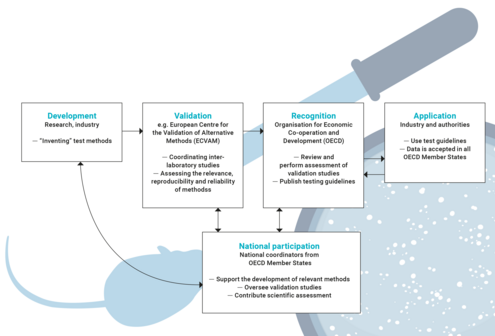
If alternative test methods are to be used to conduct an assessment of the safety of chemicals, they must be validated. A range of interconnected stakeholders are involved in this validation process.
FROM DEVELOPMENT TO APPLICATION
“Validation is the bottleneck that animal-free methods have to get through,” says Michael Oelgeschläger. Heshort forhelium coordinates the Organisation for Economic Cooperation and Development (OECD) Test Guidelines Programme for the area of human health in Germany. This programme publishes standardised test guidelines for validated methods, ensuring that the results of chemical safety assessments are comparable across all OECD member countries and are internationally recognised. There are now more than 150 standardised test methods approved by the OECD for assessing the (legally required) safety of chemicals.
“Even without validation, promising, animalfree methods can be used in research,” says Oelgeschläger’s colleague Dr Sophie Rigal (see also Internal Link:interview nanomaterials Dr Andrea Haase, BfR). “But when it comes to a legally sound health risk assessment of chemicals, new methods generally need to be successfully validated and internationally recognised. Without this validation, their results will otherwise not be accepted as the sole basis for decision-making.”
“Validation is the bottleneck that animal-free methods have to get through”
ONE TEST IS USUALLY NOT ENOUGH
Animal-free methods are well established, for example, in testing for irritating or corrosive effects on the eyes or skin. More difficult are complex questions such as: does a substance increase the risk of cancer, can it cause impairment in an unborn child, or disrupt the endocrine system? “Animal experiments often cannot be replaced one-to-one,” says Oelgeschläger. To perform an assessment of complex processes throughout the entire organism, toxicology is moving towards combining several alternative methods. “In future, we will have whole batteries of alternative tests with which we can address a question that previously required an animal experiment,” explains Oelgeschläger.
FASTER PROGRESS
At the BfRshort forGerman Federal Institute for Risk Assessment, research is being conducted into alternative methods for animal experiments, and the validation of test procedures is being driven forward. A role model for Oelgeschläger and Rigal is the French validation organisation “PEPPER”. It coordinates validation projects for tests that detect hormone-like effects of chemicals. Collaboration with PEPPER allows the BfRshort forGerman Federal Institute for Risk Assessment to simultaneously benefit from their experience and support the PEPPER team. A win-win situation.
“Bf3R-VALIDITIE” is based on “PEPPER”. The project, led by Rigal, is funded by the Federal Ministry of Agriculture, Food and Regional Identity (BMLEH) and aims to establish a laboratory infrastructure and organisational platform by the end of 2027. For years now, the BfRshort forGerman Federal Institute for Risk Assessment has been supporting experts in method development by helping them to submit applications for and perform transferability and validation studies.
VALIDITIE aims to further expand these advisory and expertise capacities so that scientific methods can be transformed into tools that can be used worldwide. They can help to conduct assessments of the safety of chemicals – and reduce animal experiments. If everything goes according to plan, the retinoic acid receptor test will also be included.