Note concerning the publication date of BfR2GO
BfR2GO 1/2026 was released in June 2026. The next issue will be published in December 2026. Internal Link:Subscribe
Chemical chic

Listen to the article:
published
From the moment we are born, we constantly wear clothes directly against our skin. Chemicals are essential for their manufacture. Is this a problem?
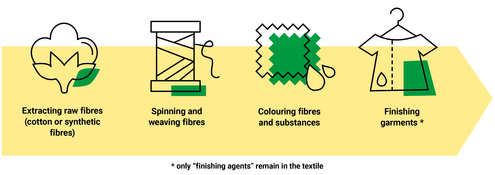
Blouses in bright colours, antibacterial tights and waterproof jackets – modern clothing is not only meant to look good, but also to be functional and practical. Many chemicals are used in their manufacture, from the extraction of the raw fibre through its processing during spinning, weaving and colouring right through to the completion of the garment. If textiles are designed with special properties, more chemicals tend to be used. But even without “special requirements” for the clothing, textile production without chemical additives is virtually impossible nowadays.
Many of the chemicals used are no longer present in the finished product. Finishing agents, however, which provide the textiles with special properties, remain in the garment. Under certain circumstances, they may leach out of the fibre and enter the body via the skin. Is this a health concern? “Clothing manufactured in accordance with the regulations applicable in this country generally poses no health risks to consumers,” says Suna Nicolai, who assesses the safety of consumer products at the German Federal Institute for Risk Assessment (BfRshort forGerman Federal Institute for Risk Assessment). “Various laws contribute to this, regulating a range of problematic substances.”
LIMIT VALUES PROVIDE PROTECTION
From a legal perspective, clothing textiles are classified as consumer goods and, according to the German Food, Consumer Goods and Feed Code (LFGB), must not pose a hazard to the health of consumers. For individual chemicals, there are specific provisions, such as limit values or bans on use, which are laid down, among other places, in the European REACH Regulation. For example, there are limit values for certain plasticisers and for other carcinogenic, mutagenic or reprotoxic (CMR) substances.
Legal provisions also apply to certain substances from the group of “forever chemicals” known as PFAS (see feature article starting on p. 8). The use of some of these problematic fluorinated chemicals – previously used in outdoor clothing due to their water- and oil-repellent properties – has now been banned, and further PFAS are set to be phased out. It is good to know that there are alternatives to these water-repellent substances in outdoor clothing.
In addition, numerous azo dyes, the largest group of dyes, are regulated. As a result of the activity of bacteria on and in the body, primary aromatic amines can be released from these dyes. These are organic compounds, some of which can be carcinogenic or mutagenic. A total of 22 of these harmful degradation by-products are listed under REACH. The use of hundreds of azo dyes is therefore effectively prohibited, as the limit values are so strict that they amount to a ban on use.
Chemicals are essential for clothing
Chemicals are used at every stage of the manufacturing process.
WASH FIRST, THEN WEAR
However, there are hundreds of other azo dyes whose effects on the body are not yet fully understood. “For many substances, there is currently insufficient data available for hazard classification,” says Suna Nicolai. “However, data on the release of dyes from clothing textiles show that contact with these dyes is minimal in most cases. This also results in a low risk.”
Consumers cannot tell which chemicals are present in textiles when purchasing; there is no corresponding labelling requirement. Instructions such as “wash separately” or “wash with similar colours” suggest that dyes may be released. “It is therefore a good idea to wash clothes before wearing them for the first time,” says Nicolai. “This is because the amount of chemicals that could potentially be released decreases with every wash.”
Consumers should also consider whether they really need textiles with special properties, such as those that are non-iron or water-repellent.