Note concerning the publication date of BfR2GO
BfR2GO 1/2026 was released in June 2026. The next issue will be published in December 2026. Internal Link:Subscribe
An excess dose of caution?
Listen to the article:
published
When hazard becomes risk: The planned classification of ethanol threatens its use as a disinfectant and shines a spotlight on the question of how chemicals should be assessed.
As a disinfectant, alcohol is an indispensable part of our daily lives. In hospitals and doctors’ surgeries, in industry or in public buildings, the substance known chemically as ethanol has long proven effective against bacteria, viruses and fungi. It is all the more surprising, then, that the future of this substance has recently been under discussion in the European Union – at least its use for disinfection, not as an ingredient in wine and beer. It is a fate that iodine and other biocides – agents against harmful organisms such as bacteria, viruses and fungi – may also share under certain circumstances. How did it come to this?
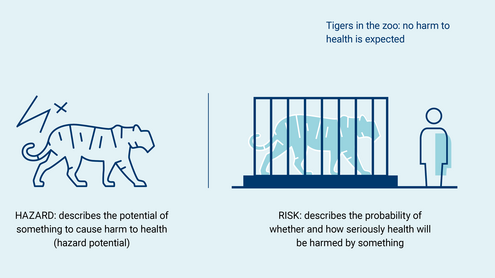
At the root of this development lies the distinction between hazard and risk. Both terms are often used synonymously, but scientifically speaking there is a significant difference between them. A “hazard” is something that has the potential to cause harm. “Risk”, on the other hand, refers to the probability that a hazard will actually cause harm.
THE TIGER AND THE DOSE
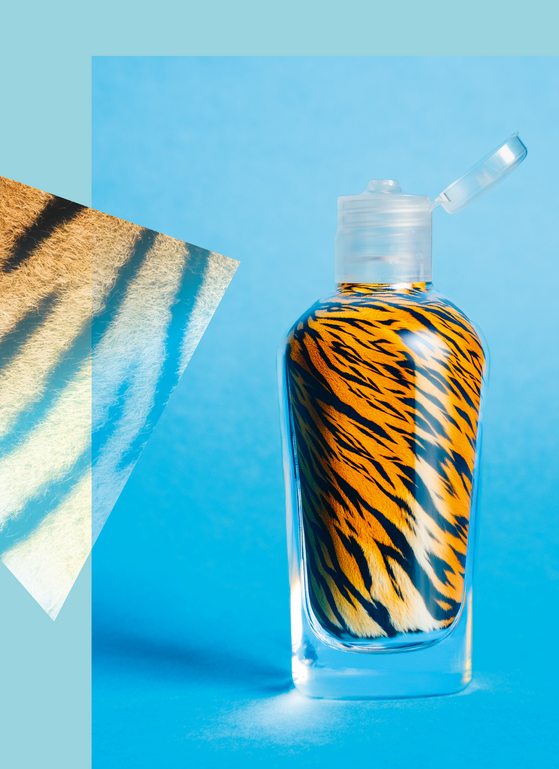
To illustrate the point simply: a tiger is a hazard to other living beings, such as humans. However, if the tiger is in a cage, the risk of becoming prey is low. It only increases once the cage is opened. In relation to chemical substances, this means that the amount of a substance ingested – the dose – determines the risk to humans. A very small dose of a hazardous substance does not pose a high risk (tiger in a cage), whereas a large dose does (tiger roaming free).
“The dose makes the poison” – this insight comes from the physician Paracelsus, who lived in the 16th century. To this day, it remains almost universally valid and forms the basis of the science of toxic substances, known as toxicology. Risk is a key consideration worldwide when it comes to assessing the potential harm posed by chemicals. In the EU, chemicals (under the REACH Regulation), plant protection products (PPP), biocides, cosmetics and other products containing chemicals are regulated primarily with a view to the risks associated with them. This enables the responsible use of chemicals while ensuring a high level of protection for human health and the environment.
Hazard or risk?
In everyday language, we often use the two terms interchangeably. Scientific risk assessment, however, makes a strict distinction. Whether a potential hazard is associated with a risk depends on “exposure”: how much, how long and how often.
CLASSIFIED, LABELLED, PACKAGED
However, there are exceptions to the rule regarding risk. This applies in particular to the EU’s Regulation on Classification, Labelling and Packaging (CLP Regulation) (1272/2008), which came into force in 2009, and other European legislation that refers directly to the CLP Regulation. The regulation governs the classification, labelling and packaging of chemical substances and mixtures. The core principle is to indicate hazards as a matter of course – accordingly, hazard assessment forms the basis of the CLP Regulation. It does not take into account whether the intended use of a chemical substance is actually associated with a health risk. Classification into different hazard categories is carried out by the European Chemicals Agency (ECHAshort forEuropean Chemicals Agency).
HAZARD: ALL OR NOTHING
If a chemical possesses CMRE properties in accordance with the CLP Regulation (see box), this may mean that it can no longer be used in certain areas of application. These hazard-based “cut-off criteria” apply in particular to plant protection products (PPPs) and biocides. Instead of a differentiated assessment that takes into account the extent to which a person is exposed to the substance, an allor- nothing principle applies. The dose of a substance therefore no longer plays a role in its classification as a hazardous substance. “This regulation was certainly introduced with the best of intentions for consumer protection,” says the BfRshort forGerman Federal Institute for Risk Assessment biocide expert Dr Vera Ritz, “but after more than ten years of experience, it has to be said that expectations have not been met and the protective effect has, in some cases, been reversed.”
The problem is particularly evident with ethanol and iodine. Both are practically irreplaceable as disinfectants. Ethanol, as a chemical substance, has a probability of being classified in future under the CLP Regulation as carcinogenic and toxic to reproduction, thus meeting two CMRE criteria, even though these health effects are not a concern when used as a disinfectant – the dose taken in by the body is far too low for that, unlike, for example, with high consumption of alcoholic beverages. As a building block of thyroid hormones, iodine can adversely affect the hormonal balance in excessive concentrations, but this is not to be expected when used as a disinfectant.
Nevertheless, both substances face the threat of being phased out, or at least facing significant restrictions on their use as biocidal active substances in disinfectants, if the CMRE properties become decisive cut-off criteria in the relevant EU regulation. However, as industrial chemicals, ethanol and iodine may continue to be used in accordance with the current REACH Regulation – and, of course, wine, beer and iodine salt will not be banned.
ONE SUBSTANCE, ONE ASSESSMENT
Risk or hazard? The issue is also relevant to “One Substance, One Assessment” – the motto of an EU initiative that was enshrined in law in 2026. It provides that, despite many different regulations, a substance will in future be assessed as uniformly as possible. A common database for chemicals forms the core of this. And how should the assessment be carried out? “The only sensible approach is to adopt risk-based methods in such a harmonised assessment,” says Vera Ritz. “We will still need to use certain ‘hazardous’ substances in the future.”
THE DOSE MAKES THE POISON – THIS INSIGHT COMES FROM THE PHYSICIAN PARACELSUS AND FORMS THE BASIS OF TOXICOLOGY.
A risk-based assessment is also beneficial for EU-wide efforts to reduce the number of animal experiments. New non-animal testing methods are being researched and developed in the EU, for example as part of the extensive PARC project. These “next-generation risk assessments” provide novel insights into the effects of chemicals on the human organism at many levels. “An understanding of these biological processes is only possible if one takes the dose of a substance into account,” says Vera Ritz.
Only time will tell whether ethanol and iodine will actually disappear as disinfectants. Associations within the German healthcare industry are warning against the reclassification of ethanol, as it would complicate or even prohibit the production and use of disinfectants, medicines and medical devices. And breastfeeding women working in the medical sector would face a ban on practising their profession if ethanol were to be classified as toxic via breast milk (lactation).
At the very least, the authorisation of ethanol for use in disinfectants was recommended by the relevant ECHAshort forEuropean Chemicals Agency committee at the end of February, though without comment on a possible classification as a CMRE substance. So is the ban still on the cards? “Everything is still open,” says Vera Ritz, “but the risk exists.”