Note concerning the publication date of BfR2GO
BfR2GO 1/2026 was released in June 2026. The next issue will be published in December 2026. Internal Link:Subscribe
"We have to accept uncertainty"
Listen to the article:
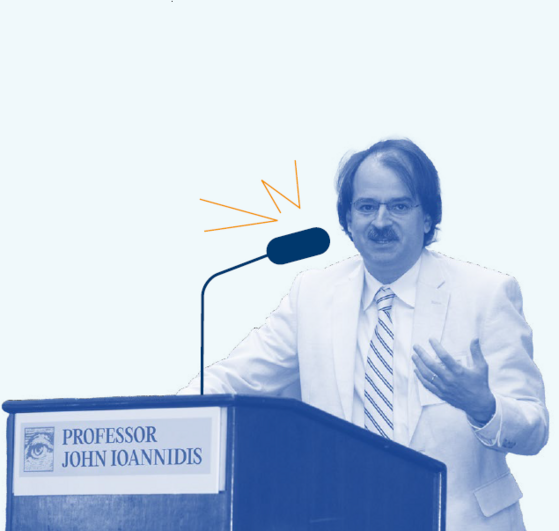
What is good science? John Ioannidis is a professor at Stanford University and one of the most cited medical researchers. The physician and epidemiologist examines the quality of scientific studies, known as meta-research.
Mr Ioannidis, you once wrote: “Doing research is like swimming in the ocean at night.” What exactly do you mean by that?
Swimming in the ocean at night can be enjoyable, mysterious, or dangerous. The same applies to science. It’s fun and exciting to be surrounded by so many unknown elements, so many unanswered questions and mysteries. At the same time, it can be a dangerous environment, full of potential for mistakes, conflict, and bias – you might easily drown or be devoured by “sharks”. Science is no simple matter. You’re constantly aware of just how little you know. But the process of discovering (and hopefully reducing) our lack of knowledge should be fun.
20 years ago, your provocative essay “Why Most Published Research Findings Are False” triggered a global debate about quality issues in research. One of your main points of criticism was the lack of statistics in studies. How have things developed since then?
I think that by now the vast majority of scientists have been sensitised to some degree to this problem. Many are actively working on finding solutions.A stable, large community of scientists has developed, which conducts research on research, known as meta-research or meta-science. We have improved methods, research practices, and the use of tools. That makes scientific research more transparent, reproducible, and hopefully even useful – when it comes to applied research. This does not mean that we have solved all problems.
What needs to be done to put science on the “right path”?
There is no magic formula. Those who provide funding, universities, institutions, organisations, supervisory authorities and other organisations that regulate science must design their reward and incentive structures in order to obtain reliable, trustworthy research results. Scientists themselves may be the most influential players in shaping more rigorous research practices. Grassroots movements to improve precision and reproducibility may have the best chances of success compared to top-down approaches. Doing research in accordance with the best standards and methods and with a minimum of bias should not be seen as a burden or as bureaucracy. On the contrary, it is integral to good science. At the same time, we need evidence about all the proposed and promoted interventions that try to change research practices. Many proposed interventions may seem reasonable, but they may not work when tested rigorously.
During the pandemic, you criticised measures such as school closures and faced a lot of opposition.
I believed that, based on the knowledge available back then, school closures and other aggressive attempts to isolate the virus would likely bring no additional benefit compared to more targeted and moderate measures, and might even cause major harms. Based on what we know now, these aggressive measures did not save any lives, but may even have indirectly cost human lives and negatively affected school education, mental wellbeing, health systems, the economy, and society at large. At the time I believed that masks and vaccinations would be efficient. I was presumably right with respect to vaccinations, but probably I was wrong about masks, since the best current studies suggest they had no great effect.
What lessons should science learn from the pandemic?
Rules are often not the best path forward. In the long term they can cause more problems than the potential moderate use of one’s own strategies. I am afraid that the loss of trust in science and public health has been fed by irrational rules and regulations. We should all learn from our mistakes and commit to using rigorous scientific methods, avoid merging politics with research or mistaking influencers for scientific evidence. We have to accept uncertainty and be willing to revise our views when better evidence emerges.