natural
from plant or animal sources, e.g. the green leaf pigment chlorophyll (E140) from plants
BfR2GO 1/2026 was released in June 2026. The next issue will be published in December 2026. Internal Link:Subscribe
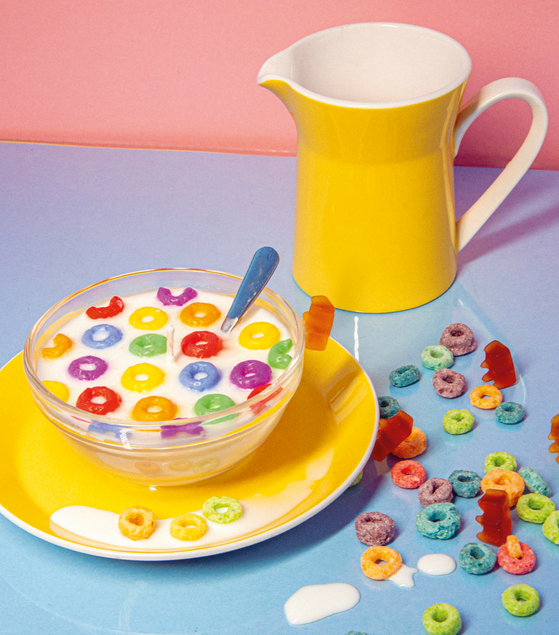
Food colours are intended to make food look appetising and attractive – for days, weeks, even months. They can be identified on packaging by their “E numbers”. They must not be harmful to health.
Food colours are added to many foods to alter or enhance their natural colour. For example, butter gets its yellow colour from the addition of beta-carotene, while sweets are coloured blue using indigotine. Sometimes food colours are also used to make a food product more appealing, for example by giving it an unusual or striking appearance. But not all foods are allowed to be coloured – milk, sugar, bread, fruit, vegetables and mushrooms, for example, are not.
There are currently 40 food colours authorised in the European Union (EU). We come across them in many products in the supermarket – and they provoke mixed feelings, as a regular survey by the German Federal Institute for Risk Assessment (BfRshort forGerman Federal Institute for Risk Assessment) shows: just under a quarter of the respondents say they are “very concerned”. A further third say they are “not at all” concerned about the colours. However, more than a third of respondents feel they are not well informed about the substances.
Food colours belong to food additives and may only be used in the EU after being authorised. “The prerequisite is that the intended conditions of use do not, on the basis of the scientific evidence available, pose a safety concern to the health of the consumer,” says Dr Rainer Gürtler, a food toxicologist at the BfRshort forGerman Federal Institute for Risk Assessment, quoting the EU Food Additives Regulation. The health risk assessment is carried out by the European Food Safety Authority (EFSAshort forEuropean Food Safety Authority), which examines extensive data on possible adverse health effects and potential intake levels. Substances that are mutagenic and/or carcinogenic are not authorised. “It does not depend on whether a substance is natural or synthetic,” explains Rainer Gürtler, “but rather on its chemical structure.”
As research constantly generates new knowledge, assessments of health safety and, consequently, the authorisation of food colours are regularly reviewed. The EU’s current review programme stipulates that all food colours authorised before 20 January 2009 must undergo a re-evaluation at EU level. This was applied, for example, to titanium dioxide: the use of this white pigment as a food colour (formerly E 171) was subsequently no longer considered safe due to a possible genotoxicity, and its authorisation was withdrawn in 2022.

For some food colours, EFSAshort forEuropean Food Safety Authority still requires further clarification for the re-evaluation. This concerns, for example, particle sizes and their distribution, as well as the possible occurrence of nanoparticles, which would necessitate a specific assessment. Consequently, some food colours have not yet been finally (re)assessed due to a lack of data or identified uncertainties. “However, there is currently no evidence to justify health concerns regarding authorised food colours,” says BfRshort forGerman Federal Institute for Risk Assessment expert Gürtler in summary.
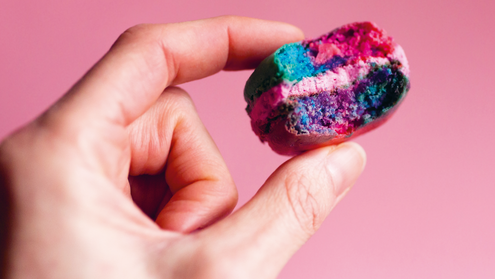
Certain substances have repeatedly been the subject of debate in the past: azo dyes. “The issue is whether they undergo chemical changes to form the substance aniline,” explains Gürtler. Aniline is potentially mutagenic and carcinogenic. In this regard, EFSAshort forEuropean Food Safety Authority conducted a re-assessment of the azo dye Red 2G (formerly E 128) in 2007. The substance is no longer authorised as a food additive.
On the other hand, a (weak) suspicion of a potential genotoxic effect that existed some time ago for Allura Red AC (E 129) was not confirmed in subsequent adequate studies. “The uncertainties that existed at the time have thus been resolved,” says Gürtler.
Anyone wishing to avoid certain food additives can do so when shopping: the E numbers listed on the packaging indicate whether a food product contains colours. E 100 to E 180 or the names of the colours are given in the list of ingredients for packaged foods, together with the term “colour”. For example, “colour annatto” or “colour E 160b”.
If food colours are present in unpackaged food or in dishes, the respective retail outlets or catering establishments must provide information accordingly.