Note concerning the publication date of BfR2GO
BfR2GO 1/2026 was released in June 2026. The next issue will be published in December 2026. Internal Link:Subscribe
Do PFAS migrate from animal feed into food?

Listen to the article:
published
Agricultural scientist Dr Robert Pieper and his team at the BfRshort forGerman Federal Institute for Risk Assessment are investigating the path of undesirable substances from the trough to the table.
Dr Pieper, PFAS are currently the subject of intense debate as a health risk. Does animal feed contaminated with PFAS play a role for humans?
Humans ingest PFAS largely via animal food products, such as fish, meat, milk and eggs. Naturally, feed and drinking water can play an important role. Furthermore, PFAS may be present in the soil, which animals ingest in small amounts. To trace the path of PFAS from feed, drinking water and soil into food, we conduct transfer studies at the BfRshort forGerman Federal Institute for Risk Assessment. The aim is to fill knowledge gaps. Together with the Federal Ministry of Agriculture, the Federal Office of Consumer Protection and Food Safety and the German federal states, we have also carried out a monitoring for PFAS in feed for the first time in Europe to gain an understanding of “background contamination”.
What exactly are transfer studies?
These are feeding studies involving livestock, which we conduct both in collaboration with other national and international institutions and at the BfRshort forGerman Federal Institute for Risk Assessment research farm in Berlin-Marienfelde. In these studies, the animals are fed with feed containing PFAS. This may be feed from already contaminated areas or feed that has been artificially contaminated with PFAS. We then measure what accumulates in eggs, meat or milk over a period of time – in other words, the extent of the transfer. For example, using “naturally” contaminated chicken feed, we investigated how much of the PFAS compound is transferred into the eggs. It has been shown that PFAS compounds from the feed are transferred to varying degrees into the liver, muscle or eggs. Each of the different PFAS behaves differently, and the extent of transfer varies depending on the animal species and food product. This makes the issue highly complex.
In the EU, maximum levels apply to four PFAS compounds in selected animal food products. Are there similar efforts regarding feed?
Feed is key to ensuring compliance with PFAS maximum levels in animal food products. However, a solid database on background PFAS contamination in feed is required before appropriate legislation can be introduced. Our transfer studies can be helpful in this regard, and our publications on PFAS transfer from feed are attracting considerable attention across Europe. It is relatively straightforward to calculate, working backwards, which PFAS concentrations in feed should not be exceeded in order to achieve compliance with the maximum levels. One tool we have developed for this purpose is the “ConTrans” software.
What is “ConTrans” all about?
External Link:“ConTrans” is a publicly accessible web tool, i.e. an internet application, which can be used to predict the transfer of undesirable substances such as PFAS from feed into animal food products and also to determine whether maximum levels are exceeded. The programme also enables an assessment of the maximum concentration of a substance in feed that is permitted in order to ensure compliance with the maximum level in food. It has proven to be an important tool for regional authorities in the German federal states and for regulatory bodies worldwide.
What have your feed monitoring results for PFAS shown?
A key finding is that the concentration of PFAS in feed is very, very low in most regions. This is, of course, good news for consumer health protection and feed safety.
From trough to plate
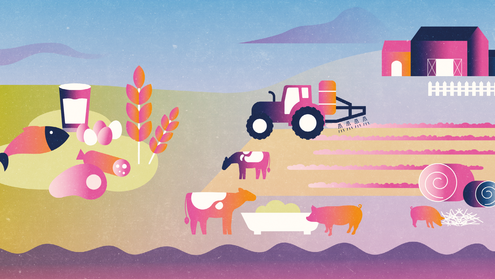
PFAS accumulate in soil, bodies of water and in groundwater. Via the food chain, they therefore end up primarily in (animal) food products.