
Note concerning the publication date of BfR2GO
BfR2GO 1/2026 was released in June 2026. The next issue will be published in December 2026. Internal Link:Subscribe
An everlasting challenge
Listen to the article:
published
PFAS, which are widely used as industrial chemicals, are proving to be long-lasting
“forever chemicals” in the environment. The BfRshort forGerman Federal Institute for Risk Assessment is investigating the extent to which certain PFAS can affect health.
How long does forever last? One could philosophise about this at length, but in the case of “forever chemicals”, one can say: probably quite a while. The term “forever chemicals” refers to per- and polyfluoroalkyl substances, or PFAS for short. They consist of chain-like carbon molecules to which fluorine atoms are bonded.
PFAS are a group of fluorinated industrial chemicals comprising thousands of compounds. Due to their properties, they are used in numerous industrial processes, technical applications and consumer products. The substances are resistant to high temperatures and aggressive chemicals, cannot be broken down in the environment, or only to a very limited extent, and are therefore extremely durable. Despite all their potential advantages, this is a major drawback.
LONG-LASTING IN THE ENVIRONMENT
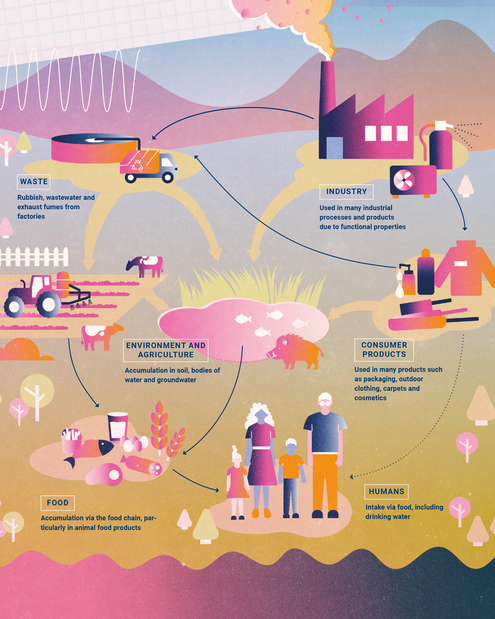
It is precisely this durability that poses a problem for environmental protection and from the perspective of consumer health protection. Because PFAS accumulate in the environment as well as in plants and animals, they reach humans in very small amounts on a daily basis, particularly via the food chain. Internal Link:(see interview Dr Robert Pieper, BfR: Do PFAS migrate from animal feed into food?)
In humans, some of the ingested PFAS accumulate over time. When it comes to excretion from the organism, individual PFAS compounds behave very differently. For some long-chain PFAS, it can take what seems like forever – several years – for a PFAS molecule to leave the organism. Short-chain PFAS, on the other hand, are excreted after just days or weeks.
PFAS are linked to a range of health effects. “A key factor is the long retention time of certain long-chain PFAS in the body, which leads to comparatively high concentrations,” explains Dr Ulrike Pabel, a PFAS expert at the German Federal Institute for Risk Assessment (BfRshort forGerman Federal Institute for Risk Assessment). And since, according to the “basic law” of toxicology – the science of toxic substances – the dose makes the poison, this accumulation can lead to PFAS concentrations that have undesirable effects on humans.
CIRCULATING IN THE CYCLE
But how can these effects be detected? This question is not easy to answer for various reasons. In the human kidney, certain long-chain PFAS are transported back from the urine into the bloodstream, which explains their long retention time in the body and their accumulation. Rodents, on the other hand, excrete the substances much more quickly. This makes it difficult to transfer results from animal studies to humans.
Epidemiological studies therefore play a key role in the health risk assessment of PFAS. By observations within population groups, researchers attempt to identify risk factors for specific health problems, among other things. “Epidemiological studies can be used to investigate statistical associations between PFAS exposure, as measured in the blood, and health effects,” says Pabel. “However, it is generally not possible to establish a clear cause-and-effect relationship.”
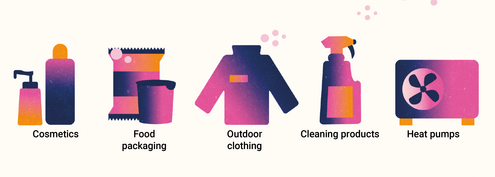
Occurrence of PFAS in everyday life (selection)
EVERYWHERE IN THE ENVIRONMENT
There are further challenges: people are exposed to various PFAS, which may have different effects. And as the compounds are found everywhere in the environment, there is no “PFAS-free” control group for comparison. Age, gender, genetic predisposition, lifestyle and the level and duration of exposure to PFAS also play a role. Exposure can vary depending on regional environmental contamination.
Based on current knowledge, there is relatively strong evidence that children with higher PFAS concentrations have lower levels of antibodies in their blood serum following a standard vaccination. “PFAS affect the immune system,” explains Pabel. “But the extent to which this influences the immune response has not yet been conclusively clarified.”
Other effects of higher PFAS exposure in humans include an increase in blood lipid levels, particularly total cholesterol and LDL cholesterol (a risk factor for cardiovascular disease), an increase in a liver enzyme in blood serum (indicating a liver disorder) and reduced birth weight. It is not yet known how these effects arise. There is less evidence for other effects that are also discussed as health risks associated with PFAS.
How PFAS enter the environment and the human body
A LONG-LASTING QUARTET
By far the best-studied are the four longchain PFAS compounds perfluorooctanoic acid (PFOA), perfluorooctanesulfonic acid (PFOS), perfluorononanoic acid (PFNA) and perfluorohexanesulfonic acid (PFHxS). They belong precisely to the substances that are difficult to excrete and that accumulate in the body. The four PFAS account for around 90 percent of the PFAS detected in the blood.
How much PFAS in the body is “too much”? In 2020, the European Food Safety Authority (EFSAshort forEuropean Food Safety Authority) published a tolerable weekly intake (TWI) of 4.4 nanograms (ng, equivalent to one billionth of a gram) per kilogram of body weight per week for the sum of the four PFAS mentioned. This describes the amount of a substance in food or drinking water that can be ingested weekly over a lifetime without posing a significant risk to health.
The TWI was based on data from a study of one-year-old children. This study revealed a link between higher concentrations of PFAS and lower concentrations of vaccine antibodies.
Breastfed infants can ingest PFAS via breast milk. The TWI takes into account the transfer of long-chain PFAS from mother to child during breastfeeding. As long as the mother’s PFAS intake does not exceed the TWI, even infants who are breastfed for a long time are protected. This also applies to the rest of the population groups.
PFAS LEVELS IN THE POPULATION
According to a 2021 estimate by the BfRshort forGerman Federal Institute for Risk Assessment, the median PFAS intake among adolescents and adults is within the range of the TWI. For around 50 percent of them, long-term intake via food therefore exceeds the TWI as a health-based guidance value (HBGVshort forHealth-Based Guidance Value). However, this estimate is subject to considerable uncertainty. Data on PFAS blood levels in the population – the internal exposure – suggest that the TWI is exceeded in a smaller proportion of the population.
The good news is that long-chain PFAS such as PFOS and PFOA are now strictly regulated and largely banned in the European Union (EU). Over the past few decades, there has been a significant decline in the levels of these substances in the blood. “Compared to 1990, the concentration of PFOS has decreased by 90 percent and that of PFOA, PFNA and PFHxS by 70 percent,” reports Pabel. So far, no new PFAS have been identified that accumulate significantly in humans and are therefore particularly problematic.
So, is the PFAS “peak exposure” already behind us? Regulatory authorities and scientists have so far focused primarily on individual long-chain PFAS due to their long retention time in the body. Less prominent are other groups of PFAS, some of which are produced as alternatives to the compounds regulated to date. “Given the size of the PFAS group, it is not possible to fully capture all individual substances,” says Pabel.
EXTENSIVE RESTRICTIONS UNDER DISCUSSION
In the EU, a far-reaching restriction on PFAS is under discussion at the suggestion of the European Chemicals Agency (ECHAshort forEuropean Chemicals Agency). “Such a measure could lead to reduced release into the environment, and as a result, humans would also be exposed to lower levels of PFAS in the long term,” explains Pabel. “However, because these substances remain in the environment for such a long time, this will still take some time.”
The BfRshort forGerman Federal Institute for Risk Assessment will continue to conduct assessments of the health risks posed by PFAS. These substances serve as a striking example of the inseparable link between the environment and human health. And that will undoubtedly remain the case forever.