
Note concerning the publication date of BfR2GO
BfR2GO 1/2026 was released in June 2026. The next issue will be published in December 2026. Internal Link:Subscribe
Omega-3 fatty acids

Listen to the article:
published
They are primarily promoted on social media as beneficial to health. Our fact sheet shows what omega-3 fatty acids can really do.
What are omega-3 fatty acids?
They belong to the group of polyunsaturated fatty acids. The most important types include alpha (α)-linolenic acid (ALA), eicosapentaenoic acid (EPA) and docosahexaenoic acid (DHA).
Why does the body need omega-3 fatty acids?
They play an important role in:
- Cell structure and function
- The development and growth of the (unborn) child
- Anti-inflammatory effect
- Fat metabolism
- Blood pressure regulation
Recommended daily intake
Of the omega-3 fatty acids, only ALA is clearly essential. This means that it cannot be produced by the body and must therefore be taken in via food.
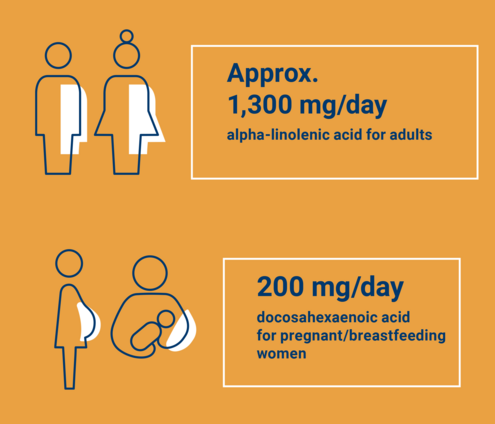
The German Nutrition Society (DGE) estimates that an ALA intake of 0.5 percent of daily energy intake is sufficient to meet the needs of people of all age groups. For middle-aged men and women, this corresponds to approximately 1,300 milligrams (mgshort formilligram) of ALA per day. The body can use ALA to produce the long-chain omega-3 fatty acids EPA and DHA.
As DHA in particular is important for the development and growth of children, even before birth, the DGE recommends that pregnant and breastfeeding women should consume at least 200 mgshort formilligram of DHA per day.
Good sources
ALA is found almost exclusively in plant-based foods, whereas EPA and DHA are primarily taken in via oily sea fish. The requirement for DHA and EPA can easily be met by eating one to two portions of oily fish per week. However, pregnant and breastfeeding women should avoid certain types of fish, such as tuna or redfish, due to their high concentrations of methylmercury. Pregnant and breastfeeding women who do not eat fish should take a DHA supplement after consulting their doctor.
For fish-free nutrition
People who do not eat fish can produce EPA and DHA from ALA by specifically consuming plant-based foods with a high ALA concentration (such as rape and walnut (oil) or linseed (oil)). However, the same amounts as in a fish-based meal cannot be achieved.

Is a dietary supplement advisable?

In the BfR’s view, healthy people who eat fish regularly do not need omega-3 fatty acid supplements.
For people with heart disease or relevant risk factors, taking higher doses of around 2 grams (g) of DHA/EPA per day may lead to an increased risk of atrial fibrillation. In such cases, omega-3 fatty acids should not be taken as a supplement on one’s own initiative, but only after consulting a doctor.
Can seaweed be an alternative?
Seaweed also contains DHA and EPA, albeit in very varying amounts. Some types of seaweed also have high iodine content Internal Link:(see “Risky sources of iodine”), which can pose a health risk if consumed in large amounts.