
Note concerning the publication date of BfR2GO
BfR2GO 1/2026 was released in June 2026. The next issue will be published in December 2026. Internal Link:Subscribe
A successful experiment

Listen to the article:
Reducing, refining, and replacing animal experiments: the German Centre for the Protection of Laboratory Animals (Bf3R) is committed to this “3R” principle. We reflect on what has been achieved in ten years, and consider what lies ahead.
It all starts with an idea. And time is of the essence. The year is 2014, and the German Federal Government has signalled that it wants to do more to protect laboratory animals as part of its initiative for animal well-being. Ideas are needed quickly. “Over the course of one weekend, we sketched out over a few pages how we wanted to put our ideas into practice,” the biologist Dr Michael Oelgeschläger says, looking back. “We had the idea of a ‘centre of excellence’ with various focus points. Once the concept was expanded, policy-makers followed us.”
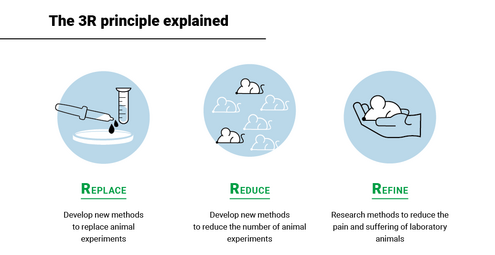
Eleven years later, this idea of a centre of excellence has become the German Centre for the Protection of Laboratory Animals (Bf3R), which was established in 2015. “3R” refers to the three principles: the replacement, reduction, and refinement (improvement) of the living conditions of laboratory animals. “Since 2013, the 3R principle has been anchored in German law, in the form of the amended German Animal Welfare Act and the Ordinance on the Protection of Laboratory Animals,” says Oelgeschläger, who was involved in the Bf3R from the very start and is now its acting director.
ONLY WHAT’S TRULY ESSENTIAL
The 3R principle “materialised” in Berlin-Marienfelde, at the premises of the German Federal Institute for Risk Assessment (BfRshort forGerman Federal Institute for Risk Assessment). The Bf3R is part of the BfRshort forGerman Federal Institute for Risk Assessment and is rooted in the Centre for Documentation and Evaluation of Alternatives to Animal Experiments (ZEBET), which was itself founded as part of the BfRshort forGerman Federal Institute for Risk Assessment back in 1989. Limiting animal experiments to what’s truly essential, and affording laboratory animals the best possible protection is the main task that the Bf3R has “inherited” from the ZEBET.
ADVICE AND TRANSPARENCY
The centre’s role puts it in a challenging position. It has to mediate between animal rights associations, some of which are completely opposed to animal experiments, and researchers who for various reasons consider such experiments necessary. The topic is also important to consumers, businesses, and policy-makers. The Bf3R thus has to inform, advise, and educate. These activities represent one of the Bf3R’s three pillars.
In order to inform the general public about animal experiments in Germany, an easily comprehensible and freely accessible summary of every planned animal experiment must be published. Since 2014, this has been done in the Bf3R database AnimalTestInfo.
IMPROVEMENTS AND ALTERNATIVES
In 2019, the database animalstudyregistry. org went online. Here, researchers from all over the world can register their idea for an animalbased experiment in advance. “The aim is to make the research more transparent, reproducible, and better, and thus reduce superfluous animal experiments,” says vet and Bf3R employee Dr Bettina Bert.
In addition, the Bf3R has compiled and published the official German animal experiment statistics since 2021. Ever since, the number of laboratory animals bred for research purposes but not actually used (“surplus laboratory animals”) is published each year. “Surplus or necessity?” The Bf3R held a discussion forum on these “surplus” animals in 2023. In the same year, the laboratory animal statistics showed a 22 percent drop (from 1.77 million to 1.37 million) in this group. “The Bf3R also needs to give voice to controversial topics,” Bert says. “And perhaps we helped bring about the considerable drop in the number of these animals.”
To ensure that German animal experiment legislation is consistently interpreted and applied in the country, the National Committee for the Protection of Animals at the Bf3R creates scientific statements and expert reports, and advises animal protection committees and approval authorities. A pool of external experts supports it in this task.
PRIZE-WORTHY RESEARCH
The Bf3R’s funding for research was established in 2017. It supports scientific research that complies with the 3R principle. Additionally, the centre organises the Animal Protection Research Prize of the German Federal Ministry of Agriculture, Food and Regional Identity (BMLEH). As of 2025, the prize has greatly expanded in scope (see info box on the prize winners).
BETTER CONDITIONS FOR LABORATORY ANIMALS
Improving the conditions under which laboratory animals are kept (“refinement”) is the second pillar of the Bf3R. What possibilities are there to create improved and more varied conditions for laboratory animals? This is being examined, for example, with respect to mice, whose (cage) environments should provide more variety. Refinement is also a realistic approach. After all, animal experiments, for example with respect to drug development, are unavoidable even in the longer term.
The Bf3R’s third pillar follows a broad strategy to develop alternatives to animal experiments (“replacement”).
From experiments on cell cultures and microscopically small, organ-like “organoids” to research on threadworms, fish, and shrimps: many paths are pursued, even if some only indirectly serve the end goal. Since 2024, the search engine SMAFIRA (“SMArt Feature-based Interactive RAnking”) enables researchers to find suitable alternative methods to a specific animal experiment in the scientific literature.
One key challenge is to establish alternative methods as internationally recognised test procedures – as a test guideline of the Organization for Economic Cooperation and Development (OECD). For this purpose, the reliability and applicability of the methods must be demonstrated in what is termed a validation process. Only after it is “validated” can a new method actually replace an animal experiment and thus become “standard”. The OECD test guideline represents the seal of approval for a new method.

From experiments on cell cultures to research on threadworms, the Bf3R pursues a broad strategy to develop alternatives to animal experiments.
ALTERNATIVE METHODS: SPOILT FOR CHOICE
“There are already many alternative methods,” Oelgeschläger says. “But the biggest problem is finding one that is worth validating.” The researcher coordinates the introduction of new test methods in Germany on behalf of the OECD. A national validation centre with a pragmatic focus on specific goals could accelerate the process. “A centre of this sort, in cooperation with other European institutions, would guide the development of a procedure,” Oelgeschläger says. “We could achieve a lot with relatively little money.”
Oelgeschläger sees the “European Partnership for the Assessment of Risks from Chemicals” (PARC), which was launched in 2022, as an additional important undertaking. Supporting new methods for testing chemicals without the use of laboratory animals is a PARC focus point in which the BfRshort forGerman Federal Institute for Risk Assessment is involved. “We jointly develop new strategies in order to generate precisely the data we really need,” Oelgeschläger says.
The German Centre for the Protection of Laboratory Animals will clearly have plenty to keep it occupied for another ten years at least.