
Note concerning the publication date of BfR2GO
BfR2GO 1/2026 was released in June 2026. The next issue will be published in December 2026. Internal Link:Subscribe
How much can still be in it?

Listen to the article:
Pesticide residues in food: What do guidance and limit values actually mean?
Limits are intended to protect. But the question where they can be drawn is often not easy to answer. This also applies to consumer health protection, where “limit values" are a key marker. They are intended to provide guidance in the area between “harmless” and “risky”, so that apples, lettuce and eggs can be enjoyed without hesitation. In fact, these scientifically determined values are not real limits, but rather guidance values. Deciding where exactly these guidance values should be set is also one of the tasks of the German Federal Institute for Risk Assessment (BfRshort forGerman Federal Institute for Risk Assessment). An example of this can be seen in the specifications for active substances in plant protection products.
The decisive factor for the determination (or “derivation”, as it is called in technical jargon) of a health-based guidance value is a solid scientific basis. Studies are legally required for the approval of a pesticidal active substance. These must be initiated by the applicant and submitted to the authorities. They are largely carried out on mice and rats. Typically, three groups of animals are given different concentrations of an active substance via their feed over a longer period of time. A fourth group receives no active substance and serves as a control. The following section determines whether the active substance under investigation has any effects on the organism.
GUIDE TO THE GUIDANCE VALUE
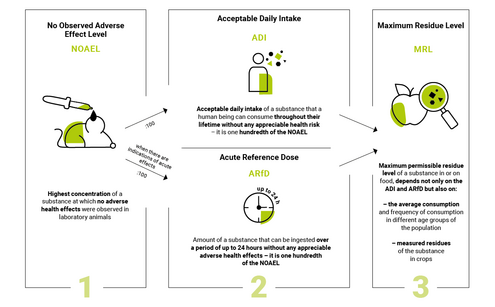
“The study showing effects at the lowest dosage is then essential for our risk assessment”, explains the BfRshort forGerman Federal Institute for Risk Assessment expert Dr Lars Niemann. “Based on this data we then determine the corresponding NOAEL, the ‘No Observed Adverse Effect Level’ – that is the highest concentration of an active substance at which no harmful effects were observed in the laboratory animals.” The NOAEL thus points the way to the guidance value.
In a second step, the ADIshort forAcceptable Daily Intake is “derived”. ADIshort forAcceptable Daily Intake stands for “Acceptable Daily Intake”. This is the amount of an active substance that a person can consume daily over a lifetime without any appreciable risk to his or her health. “The ADIshort forAcceptable Daily Intake is not transferred one-to-one from the NOAEL to humans, but is further adjusted by a safety factor, usually 100,” explains Niemann. “It is therefore only one hundredth of the NOAEL.”
How can the 100-fold “safety margin” be explained? On the one hand, it is scientifically accepted that a factor of ten is sufficient to address a potentially higher chemical sensitivity of humans compared to laboratory animals. And other hand, it is divided by ten to account for the biological differences between humans. Laboratory animals are largely genetically identical and therefore, react very similar to an active substance. Due to genetics, gender, age differences, pre-existing medical conditions and metabolic differences, the range of reactions in humans is much greater.
In addition to the ADIshort forAcceptable Daily Intake, the “Acute Reference Dose” (ARfDshort forAcute Reference Dose) also plays an important role. The ARfDshort forAcute Reference Dose refers to the amount of an active substance that can be ingested by a person over a period of up to 24 hours through food or drinking water without any appreciable adverse effects on their health. The acute reference dose (ARfDshort forAcute Reference Dose) is therefore the guidance value for a very short period, while the ADIshort forAcceptable Daily Intake takes a long period of time into account. Unlike the ADIshort forAcceptable Daily Intake, it is not always necessary to derive an ARfDshort forAcute Reference Dose for an active substance, but only when there is evidence of acute effects.
EXPERIMENT AND REALITY
The unit of the ADIshort forAcceptable Daily Intake and the ARfDshort forAcute Reference Dose is milligrams (active substance) per kilogram of body weight (mgshort formilligram/kgshort forkilogram body weight). Both are experimental values, health-based guidance values. What is still missing is their anchoring in the “real" world, i. e. the actual definition of the limit for the prevalence of an active substance in food. This is done in a third step: when setting maximum residue limits (MRLs) for a pesticidal active substance. These must be low enough to ensure that consumers take up less of the active substance than corresponds to the ADIshort forAcceptable Daily Intake and ARfDshort forAcute Reference Dose. An MRL indicates the maximum permitted residue level of an active substance in or on food.
“As guidance values, the ADIshort forAcceptable Daily Intake and ARfDshort forAcute Reference Dose, are the result of the scientific health assessment,” says Dr Jens Schubert, Vice Head of the BfRshort forGerman Federal Institute for Risk Assessment's “Pesticide Safety” department. “The maximum residue level (MRL), on the other hand, is the legally binding limit for food. If it is exceeded, the affected food product may no longer be sold and must be withdrawn from the market.”

In order to derive a maximum residue level (MRL), the BfRshort forGerman Federal Institute for Risk Assessment requires information beyond the established ADIshort forAcceptable Daily Intake and the ARfDshort forAcute Reference Dose. The BfRshort forGerman Federal Institute for Risk Assessment also requires information about how much of a food product is consumed by different age groups of the population and how much is consumed at most on a single occasion. Both factors play a role in risk assessment. Frequently consumed products such as potatoes, apples or lettuce are weighted differently over a lifetime than fruits that are only eaten occasionally such as pineapple or seasonal vegetables such as asparagus. Higher consumption may also mean the intake of higher residues. The amount consumed in a single day can be much higher than the average amount consumed. For plant protection products which can cause acute health effects, even a single consumption of a large portion of food must therefore be safe. The MRL must be set accordingly low.
“A PLANT PROTECTION PRODUCT IS NOT AUTHORISED GLOBALLY, BUT FOR APPLICATIONS IN SPECIFIC CROPS.”
FOOD WITH LIMITS
On the other hand, it must be determined how much of an active substance remains in food. One way to determine this is through field trials. In this process, a plant protection product is applied in the same manner and with the same application rate for which authorisation is envis-aged on a specific crop (such as apples, grapes or tomatoes). After harvest, the quantity of the active substance is determined that remains in the food product. “A plant protection product is not authorised globally, but for applications in specific crops, for which authorisation was requested,” explains Schubert. “The residue level depends on the crop and whether the plant protection product is applied shortly after sowing or shortly before harvest.”
Taking into account the usual consumption quantities and the active substance concentrations measured in the food products, the maximum residue level (MRL) is set so that it neither exceeds the ADIshort forAcceptable Daily Intake nor the ARfDshort forAcute Reference Dose. Its unit is milligrams (residue) per kilogram (food product), mgshort formilligram/kgshort forkilogram. “The guiding principle here is: as low as reason-ably achievable,” comments Schubert.
HOW MUCH IS ALLOWED: Determination of maximum residue levels (MRL) of pesticides
LIMITS PROTECT
Food products are only marketable if they comply with the maximum residue levels (MRL). Compliance is monitored by federal state testing laboratories, which take regular samples. In addition, retailers maintain testing laboratories and set their own “stricter” standards. But what does it actually mean when a measured residue suggests that a health-based guidance value has been exceeded? Does the guidance value mark the line between what is still safe and what is already unhealthy? “That's too simplistic,” says Lars Niemann.
“A short-term exceedance of the ADIshort forAcceptable Daily Intake does not normally indicate a health risk, because this guidance value was set on the assumption of a daily intake over a lifetime.” The situation is different if the measured residue is above the ARfDshort forAcute Reference Dose: “In this case, a possible impairment cannot be ruled out from the outset, as even a single dose can have consequences.” The risk exists – but that does not mean it will necessarily materialise.