Note concerning the publication date of BfR2GO
BfR2GO 1/2026 was released in June 2026. The next issue will be published in December 2026. Internal Link:Subscribe
Repellent to the end
Listen to the article:
The European Union (EU) is discussing a broad ban on PFAS, known as “forever chemicals”. This would impact manufacturers and industry – as well as non-stick coatings in many kitchens.
They are in baking paper, outdoor jackets, fast food packaging, and, yes, in non-stick coatings on many pans and kitchen utensils: PFAS, short for “per- and polyfluoroalkyl substances”. The group of PFAS comprises more than 10,000 different industrially manufactured chemical substances, all with particularly practical properties.
“For instance, these substances are hydro- and lipophobic, very stable, and many of them can withstand high temperatures and pressure,” Dr Claudia Lorenz explains. Her work at the German Federal Institute for Risk Assessment (BfRshort forGerman Federal Institute for Risk Assessment) focuses on food contact materials. In addition to the products mentioned, PFAS are virtually everywhere. They can be found in industrial machinery, car motors, and coffee machines as well as in medical products such as pacemakers and blood bags.
EXTREMELY REPELLENT, HIGHLY STABLE
PFAS’ longevity and stability is also what makes them a problem. Once they enter the environment, PFAS essentially do not break down. This is how they earned the name “forever chemicals”. These substances break down much slower than other artificially manufactured chemicals. They spread globally through air and water and find their way into groundwater and soil as well as into plants and animals. PFAS have even been found in Antarctica.
BAN WHEREVER ALTERNATIVES EXIST
In order to reduce the accumulation of PFAS in the environment, several EU countries, including Germany, are planning to implement broad restrictions on this category of substances. To this end, the German Environmental Protection Agency (Umweltbundesamt – UBAshort forGerman Environment Agency) and the BfRshort forGerman Federal Institute for Risk Assessment are working together with partner agencies from other EU Member States to prepare a dossier comprising arguments and framework conditions. Certain PFAS are already strictly regulated or have been subject to new bans which are going to enter into force in the coming years. “In the future, production and use of PFAS might become entirely prohibited,” Lorenz explains. “Derogations might only be granted for sectors in which there are no feasible alternatives yet, such as medical products or industry machinery which are subjected to high temperatures or pressure.”
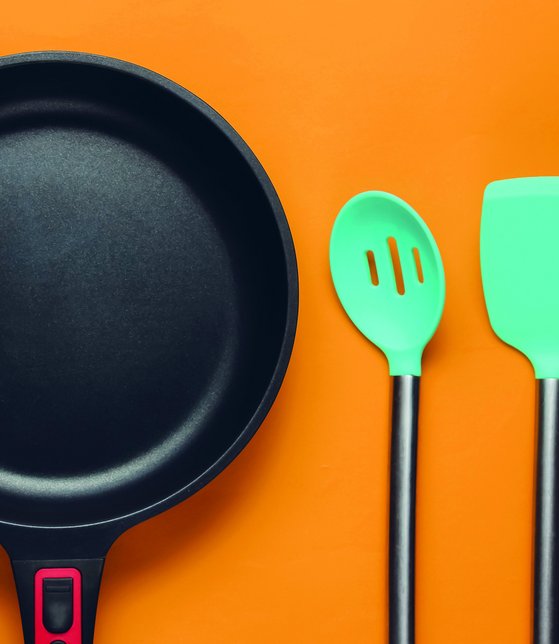
Consumers might also notice a restriction when purchasing kitchenware. After all, classic non-stick coatings, such as in pans, are typically made from polytetrafluoroethylene (PTFE). The substance belongs to the group of PFAS and is better known under the brand name “Teflon”.
HEALTH IMPAIRMENTS NOT EXPECTED FROM COATING
Non-stick coatings on kitchen utensils and associated health risks are a recurrent topic in the media. However, problems are only to be expected if the cookware is heated to temperatures of 360 °Cshort fordegrees Celsius and more, at which point vapours which are hazardous to health can be released. “That’s why an empty Teflon pan should not be placed on a hot stove,” Lorenz advises. “As long as there is water or a watery food in the pan or pot, the temperature cannot rise significantly above the boiling point of 100 °Cshort fordegrees Celsius. If food is fried with oil, the latter starts to smoke before critical temperatures are reached.”
Even if a lack of caution leads to scratches and small pieces of the coating come off and end up in the food, there is no current evidence to suggest health impairments stemming from this. “Like all PFAS, PTFE is highly inert. That’s part of what makes it so practical: nothing sticks to the pan – and nothing happens in the body, either,” Lorenz explains. “It goes in and it comes right back out.”
PFAS BAN MAINLY FOR THE ENVIRONMENT
Outside of the kitchen, however, some other PFAS have long half-lives in the human body and can affect the immune system, lipid metabolism, and the liver. Humans primarily take in these substances through drinking water and foods like fish and seafood. “This is why the manufacture and use of several PFAS is already mostly banned in the EU,” Lorenz says. Studies show that corresponding PFAS levels in human blood have decreased substantially since the mid-1990s. “The universal PFAS restriction currently under discussion is particularly related to accumulation in the environment, as this is the basis for the contamination of drinking water and foods.” An EUwide decision is expected for 2027.
ALTERNATIVE FRYING
Frying without PTFE-coating will be possible, for instance with pans having ceramic or enamel coating. Stainless steel and cast-iron pans are also options. However, these materials have less of a non-stick effect than cookware coated with PTFE. So far, there is no alternative with all of the properties that PTFE has. However, it will still be possible to prepare tasty dishes in the future.