
Note concerning the publication date of BfR2GO
BfR2GO 1/2026 was released in June 2026. The next issue will be published in December 2026. Internal Link:Subscribe
Ewwww, chemicals?!

Listen to the article:
The BfRshort forGerman Federal Institute for Risk Assessment wanted to know what chemicals mean to us in everyday life. They found out that we have mixed views and perspectives on the topic.
Skin cream, children’s toys, cleaning and plant protection products: we come into contact with chemical substances through a variety of everyday products. This means that they must be safe to handle. In Germany, the BfRshort forGerman Federal Institute for Risk Assessment assesses chemical substances based on the European Registration, Evaluation, Authorisation and Re-striction of Chemicals Regulation, or REACH for short. In order to properly communicate the risks associated with using chemical products, the BfRshort forGerman Federal Institute for Risk Assessment also identifies the knowledge and perspectives of consumers regarding everyday chemicals. A new BfRshort forGerman Federal Institute for Risk Assessment survey offers some insights.
IMAGE NAY, EFFECT YAY
The results of the survey show conflicting views on chemicals used in everyday life. The BfRshort forGerman Federal Institute for Risk Assessment found that more than half of the respondents perceive chemicals as artificial (54 %) and unpleasant (51 %). For almost half of those surveyed, chemicals were associated with thoughts of potential impairments to health (42 %) and the environment (44 %). Despite these concerns, almost the same percentage of people view the applications of chemicals positively, finding them useful (49 %) and effective (49 %).
If artificial and natural components of chemicals are examined separately, this ambivalent perception becomes more differentiated. Consumers see products with artificial ingredients far more negatively than those with natural ingredients. Around half of respondents find artificial ingredients to be unpleasant (42 %) and believe that they are more harmful to health (48 %) and the environment (55 %) – even if they consider artificial ingredients effective (52 %) and useful (44 %). However, one in two people also find natural ingredients useful (54 %) and effective (48 %). By contrast, only one in five believe that natural ingredients are harmful to health (16 %) and the environment (17 %). More than a quarter see them as pleasant (28 %).
THE MORE COMMON THE USE, THE LOWER THE CONCERN
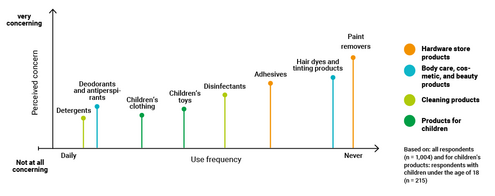
Concerns regarding chemical products seem to decrease with increasing everyday use of certain articles (see graphic). Respondents are particularly concerned about using products from the hardware store. For cleaning products, there is moderate concern. This is also the case for toys and children’s products. Overall, there is less concern among respondents when it comes to frequently used body care and cosmetic products.
EYE ON LABELS
The most important source of information regarding possible product risks is the packaging. However, the majority of respondents find indications and information on packaging to be poorly legible or not detailed enough. The majority are aware of common hazard symbols, such as an open flame (“slightly or highly flammable”) or liquid from a test tube dripping onto a hand (“corrosive”). More than a third say that they pay attention to the hazard and safety information on packaging. Up to three quarters of respondents also say they heed these warnings.
CORPORATE RESPONSIBILITY
Almost all participants see it as the responsibility of the manufacturer to ensure the safety of chemical products. Most also place responsibility with the government and with distributors. The primary responsibility borne by companies was established in the REACH Regulation. However, 86 percent of respondents were not aware of this EU regulation, which has existed since 2007. A similar survey by the BfRshort forGerman Federal Institute for Risk Assessment in 2008, i.e. shortly after the introduction of REACH, also found the regulation to be largely unknown.
The more common the use, the lower the concern
Perceived concern and use frequency of selected products
Disgust and fear around everyday chemical products? This feeling appears to be borne out by the data. However, chemicals are everywhere and natural does not necessarily mean harmless. In the same vein, not everything artificial is dangerous. For this reason, the EU has called upon institutions like the BfRshort forGerman Federal Institute for Risk Assessment within the Member States to assess and educate the public about the health risks of chemical products with which people come into contact every day.